Governing Enterprise AI at Scale Guide


How the Intake Review Gets Automated
In our last blog, we went through why a single AI model can take three to six months to clear enterprise intake. Four or five approval chains, each starting cold, each waiting on evidence a model provider was never going to hand over.
Here's the other half of that argument: what actually changes once intake gets automated.
Where the Four Reviews Actually Converge
Legal reviews licensing and IP terms. Security runs its own assessment. Risk scores business impact against its own rubric. Compliance maps the model to NIST AI RMF, the EU AI Act, the OWASP LLM Top 10. Four teams, four forms, and almost nothing shared between them.
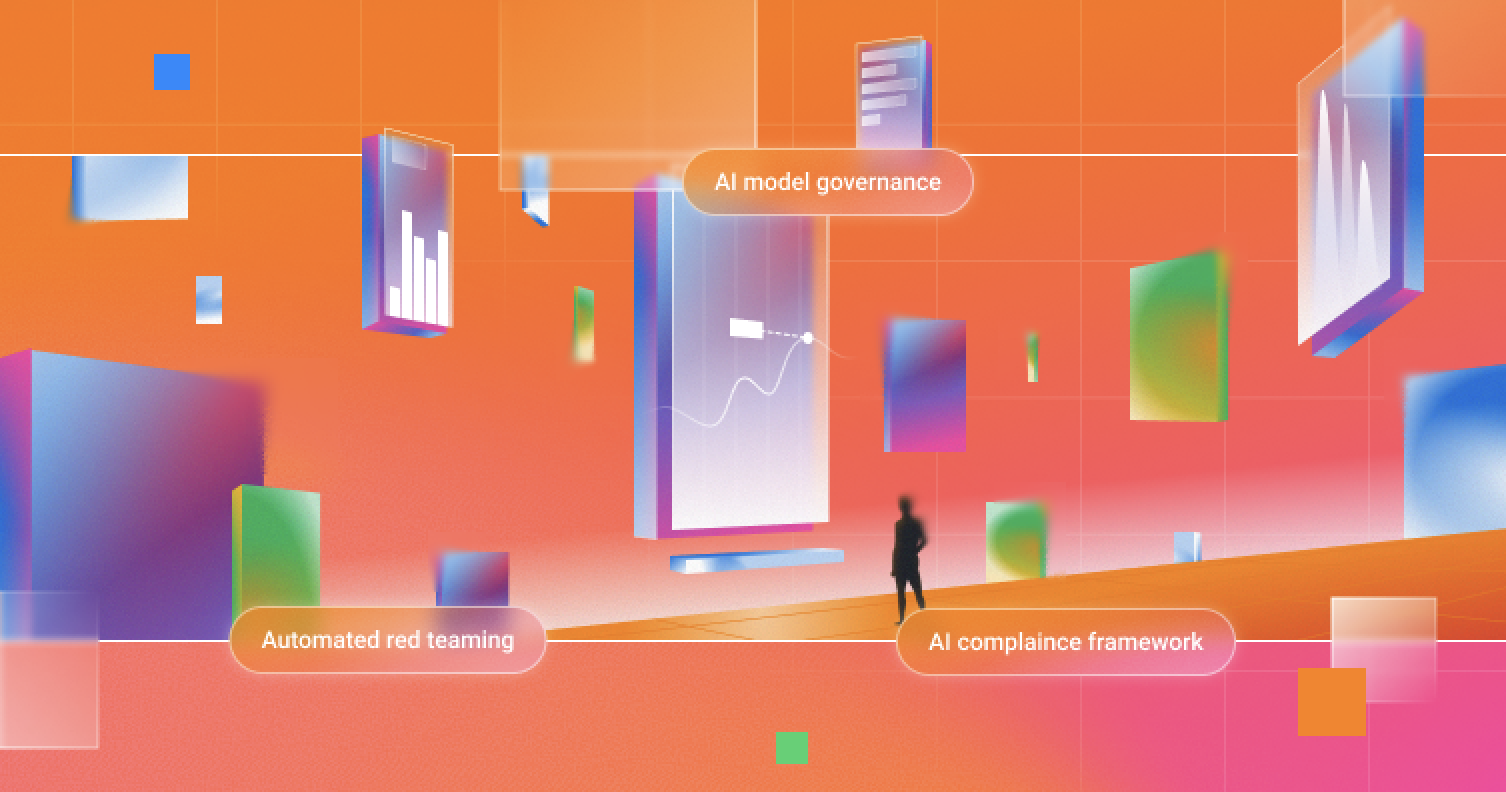
The fix isn't running that same process faster four times. It's writing down what each function actually needs as a single machine-readable policy, once. Security's attack-surface requirements, legal's licensing checks, risk's scoring thresholds, compliance's framework mappings, all captured in one place instead of four. When a requirement changes, it changes in the policy. Nobody re-explains it to four different reviewers.
What the Assessment Actually Tests
A policy sitting on its own doesn't clear anything. Something has to test the model against it, and that's where policy-driven red teaming comes in: the model gets run through the categories the policy defines, prompt injection, data exfiltration, jailbreak resistance, bias, using the organization's own synthetic data rather than a generic public benchmark.
Because the test is built from the policy itself, one pass produces evidence all four functions can use. Legal doesn't wait on its own review to finish before security starts. Compliance doesn't build its own mapping after the fact. The output already comes scored and tagged to the frameworks the organization gets audited against.
Nothing Has to Restart From Zero
Here's the part manual intake never accounts for: a model cleared in January is treated as unknown in March, the moment a provider ships a new version or the same model turns up on a second internal platform. The three-to-six-month clock resets, in full, every time.
An automated pipeline keeps a record of every model it has already evaluated, so a new version doesn't get re-tested from scratch. It gets compared against what's already on file, and the review is really just: what changed? That's the difference between a governance process that can keep up with a model release cadence measured in weeks, and one that can't.
What Changes Is the Wait, Not the Bar
None of this works by cutting corners. NIST AI RMF, the EU AI Act, and the OWASP LLM Top 10 already define what "cleared" means, and that bar doesn't move. What moves is how long it takes to find out whether a given model meets it, three to six months of four separate teams starting cold, or a same-week disposition built on evidence that was already there.
Get the Full Breakdown
The complete mechanism, how the policy engine works, what the persistent baseline actually compares, how reporting stays audit-ready, and a full requirement-by-requirement mapping of where intake stalls today versus what closes it, is in the governance brief.
Download the governance brief: Governing Enterprise AI at Scale →
.avif)
.svg)