Why AI Model Intake Takes Months and How to Fix It


Introduction
Every large enterprise is running the same experiment right now: thousands of employees reaching frontier models through a handful of sanctioned tools, engineering teams wiring agents into internal platforms, and a governance function trying to certify all of it before a model reaches production. Ask most CISOs or compliance leads where the bottleneck sits, and the honest answer usually has less to do with whether a model is safe than with how long it takes the organization to find out. A single model can take three to six months to clear intake, and by the time it does, a new version has often already shipped.
Why One Model Can Take Months to Approve
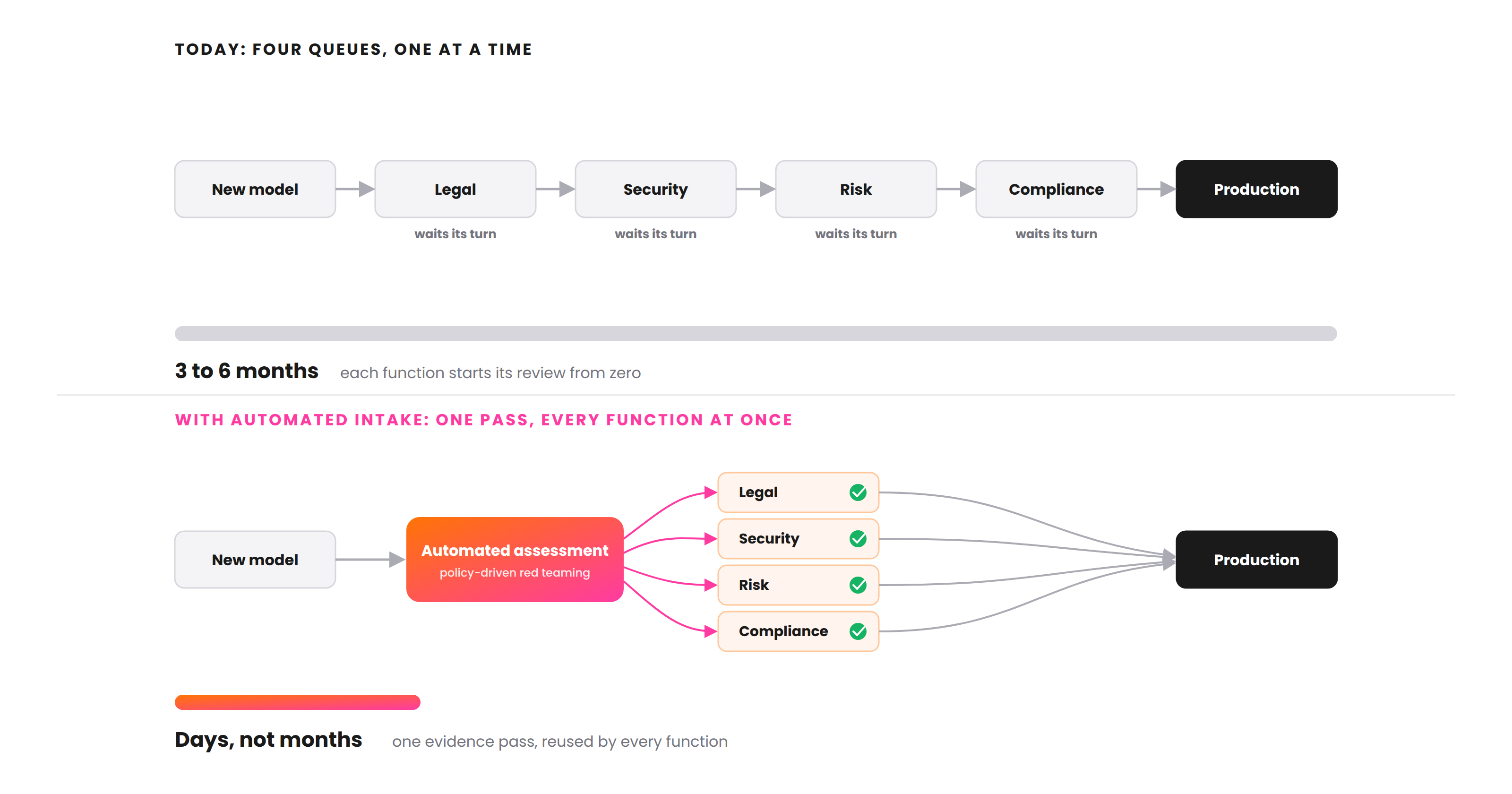
Getting a single model into production typically means clearing four or five separate approval chains that were never designed to talk to each other. Legal reviews licensing and IP terms. Security runs its own assessment, often waiting on a pen-test slot. Risk scores business impact against its own rubric. Compliance maps the model to whatever frameworks apply: NIST AI RMF, the EU AI Act, the OWASP LLM Top 10. Each function works from its own intake form, its own timeline, and its own evidence, with almost nothing shared between them.
And none of that carries forward. A model approved in January is treated as unknown in March, when the provider ships a new version or the same model shows up on a second internal platform. Without a persistent baseline, the same three-to-six-month cycle repeats in full every time, while manual red teaming, where it happens at all, cannot come close to matching a release cadence measured in weeks.
The business absorbs that delay one of two ways: product and engineering teams wait months while competitors ship, or they route around governance entirely, and model consumption becomes shadow IT that nobody can see or certify.
The Delay Is Structural, Not Incidental
It's tempting to treat this as a process problem: more people, tighter SLAs, a better intake form. It isn't. Much of the wait is spent hoping a model provider will eventually hand over documentation it was never going to provide. Commercial frontier labs don't publish training data, model weights, or a security package built for one customer's specific policy. Legal, security, risk, and compliance all end up waiting on evidence that doesn't exist, then falling back to manual testing to fill the gap, each on its own separate timeline.
The evidence that actually clears a model has to be generated, not requested: the model tested against the organization's own policy, using its own synthetic data, inside its own environment. That approach is provider-agnostic. It works the same whether the model came from a closed frontier lab, an open-weight family, or an internal fine-tune, and critically, it's reusable across every function that needs to sign off, instead of each one starting from scratch.
What Automating Model Intake Actually Looks Like
This is the shift Enkrypt AI's approach to model intake is built around: replacing the manual, sequential review cycle with a single automated assessment that every downstream function can use.
In practice, that means policy-driven red teaming that tests a candidate model in days against categories like prompt injection, data exfiltration, jailbreak resistance, and bias, using the organization's own synthetic data rather than generic benchmarks. It means capturing legal, security, risk, and compliance requirements once, as a machine-readable policy, so a single assessment produces one evidence pass instead of four separate reviews on four separate clocks. And it means every new model or version gets compared automatically against a persistent baseline, so review starts from a diff instead of from zero.
The result is evidence that's already scored and mapped to the frameworks the organization is audited against, sitting in a store every function can pull from, plus a gate in the CI/CD pipeline itself, so a new model added to a platform like Databricks or Azure AI Foundry gets scanned as part of the release instead of scheduled around a meeting.
The Takeaway
A governance process that takes months is a risk in its own right. The business either waits and falls behind, or routes around it and loses visibility entirely. Automating the assessment itself is what turns a multi-month intake cycle into a same-week disposition, without asking legal, security, risk, or compliance to lower the bar.
Enkrypt Knowledge Source:
https://www.enkryptai.com/solutions/ai-compliance-management-frameworks
Frequently Asked Questions
No. The evidence generation is automated, but the decision to approve or reject a model still sits with the same legal, security, risk, and compliance owners. What changes is how long they wait for consistent evidence before they can decide, not who decides.
It applies either way. Policy-driven red teaming tests the model as it actually behaves inside your environment, against your policy, whether it came from a closed frontier lab, an open-weight family, or an internal fine-tune. That is part of why a single evidence pass can serve all four functions at once instead of only some of them.
No. NIST AI RMF, the EU AI Act, and the OWASP LLM Top 10 already define what "cleared" means. Automation reaches that same bar faster because it stops waiting on documentation that model providers were never going to hand over, not because the bar itself moved.
Every new model or version gets compared automatically against the persistent baseline, so the review starts from a diff instead of restarting the full three-to-six-month cycle from zero.
It depends on model complexity and how deep the organization's policy goes, but most teams see initial disposition within days once the automated evidence pipeline is in place, not months.
.avif)

.svg)