
Episode 4 : Mortality as a Design Principle: Why Only Humans Have Skin in the Game


Mortality as a Design Principle: Why Only Humans Have Skin in the Game - By Merritt Baer, CSO, Enkrypt AI
One of the most surprising things about building and securing AI systems is how quickly the conversation becomes existential. Not because AI is—but because we are.
Whenever I talk with other CISOs, we inevitably wander into these deeper waters.
We talk about:
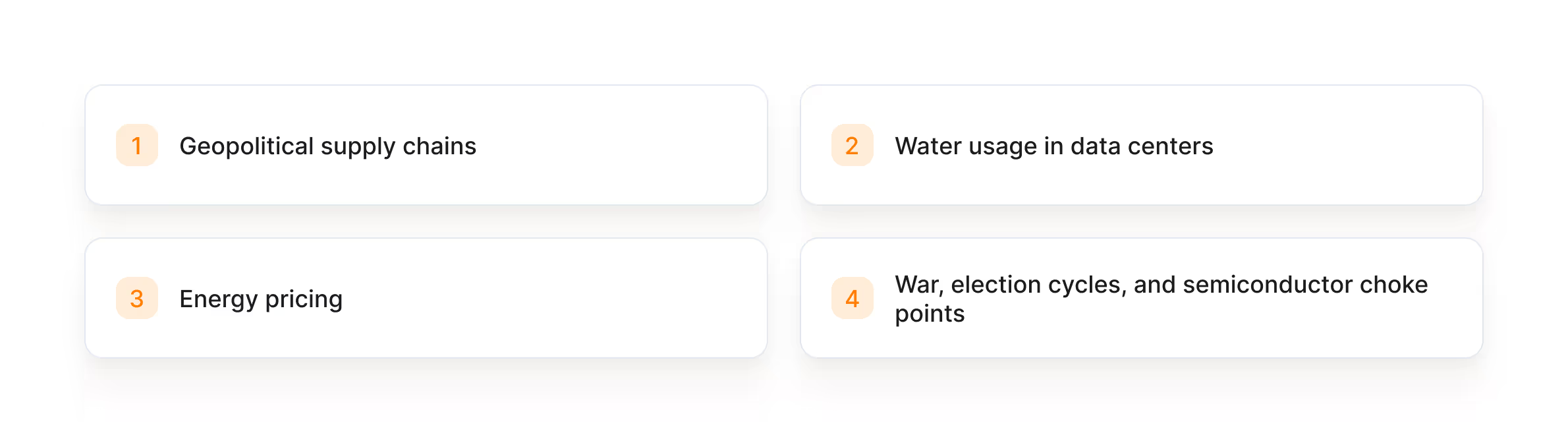
And underneath all of it sits a quiet truth:
We care about these things because they can hurt us. AI does not care because it cannot be hurt.
Mortality is what makes values real
Human ethics comes from the fact that we are breakable.
Fragile. Finite.
We suffer consequences.
When an organization mishandles customer data, someone gets harmed.
When a model behaves unpredictably in a medical workflow, someone suffers.
When automation triggers a cascading failure, someone’s real life gets disrupted.
AI does not experience consequence.
We do.
That’s why mortality belongs in the design room—even if AI will never have it.
What does it mean to design with mortality in mind?
It means we resist the temptation to treat AI like software that simply “runs.”
We treat it like a force multiplier of human outcomes. Meaning:
%20(1).avif)
Mortality is why we need reversible workflows.
Why we need human override.
Why recovery matters as much as prevention.
Why incident response for AI has to include not just logs and alerts, but people.
AI without mortality is power without stakes
This is precisely why the security function cannot be reduced to “model safety” or “alignment checks.”
Those matter—but they’re ingredients, not the meal.
The real work is in shaping systems whose failures are survivable.
Because someone—not something—will live with the outcome.
Next up
Installment #5 explores the “supply chain of values”: how macro forces like war, energy markets, and chip manufacturing quietly define the ethics and risks of AI.
Frequently Asked Questions
Designing AI systems with mortality as a principle means building safeguards that acknowledge humans bear real consequences while AI does not. This approach prioritizes reversible workflows, human override, and survivable failures over pure model safety alone.
- Treats AI as a force multiplier of human outcomes, not autonomous software.
- Requires recovery and incident response capabilities alongside prevention.
- Centers human stakes in every architectural decision.
Secure AI systems by embedding human accountability into design: implement reversible workflows, maintain human override authority, and design for survivable failures. Security cannot reduce to model safety checks alone—it must shape systems whose failures do not harm people irreversibly.
- Build incident response that includes people, not just logs and alerts.
- Ensure every automated decision can be reversed or paused by humans.
- Test recovery procedures as rigorously as prevention measures.
Mortality matters because human ethics stems from being breakable and finite—we suffer real consequences. AI does not experience consequence, so designing with mortality in mind ensures systems fail safely when they do fail, protecting the people who live with outcomes.
- Data mishandling harms real people; AI cannot be harmed.
- Medical workflow failures cause human suffering, not system suffering.
- Cascading automation failures disrupt lives, not code.
Enkrypt AI provides policy-based guardrails and governance controls that embed human oversight into AI deployments, enabling reversible workflows and survivable failures across agents, LLMs, and MCP infrastructure. The platform reduces manual compliance effort by up to 90% while enforcing human-centered design principles.
- Runtime guardrails block unsafe actions with human override authority.
- Centralized policy engine enforces accountability across all deployments.
- Real-time monitoring supports incident response with people in the loop.
Designing AI systems with human consequence in mind requires governance that treats failures as survivable. Enkrypt AI embeds reversibility and human control into your workflows—book a demo to see how it works for your organization, or start a free trial today.


.svg)